Share a home.
Not your financial life.
Rolle is designed to help people manage shared financial responsibilities without requiring them to share everything else.
Your household can see what it needs to coordinate rent and bills. Your private account information stays private.
Household: Peckham Flat
Shared with the household
- Monthly rent
- £2,150
- Your agreed share
- £720
- Electricity
- £54 ÷ 3
- Contribution status
- Paid ✓
- Personal bank balance
- Banking credentials
- Transaction history
- Other account details
Security snapshot
Six things worth knowing.
No false claims. This is just how Rolle is built. We take security very seriously.
Your data stays yours
Access is restricted by default. Rolle only makes information available where you have permission to see it.
Your card details stay with the payment provider
Your full card details do not pass through Rolle's systems.
Bank connections are protected
Sensitive bank-access credentials are encrypted and kept away from the Rolle app itself.
The app cannot move money by itself
Sensitive financial actions are checked securely on the server before they can take effect.
Protected while information moves
Connections between Rolle and its systems use modern encrypted communication.
Checked with every change
Automated security checks run throughout Rolle's development process.
A household shouldn't mean shared access to everything.
Rolle brings people together around the things they have agreed to pay together. It does not give everyone in a household access to everyone else's private financial information.
Shared with the household
- Household rent
- Agreed shares per person
- Household bills
- Contribution status
- Whether an obligation is ready
- Whether payment is complete
Kept private
- Personal bank balance
- Personal banking credentials
- Full transaction history
- Private account details
- Payment instrument numbers
- Information not needed by the household
Transactions
Connecting your bank doesn't mean giving Rolle your login.
Rolle uses Open Banking connections to enable approved banking features.
Your bank connection follows the bank's secure authorisation process. Sensitive access credentials generated through that process are encrypted before they are stored and are kept server-side rather than inside the Rolle app.
Rolle is designed so that sensitive credentials are not bundled into the app on your phone.
You remain in control of the permissions you grant through the relevant banking process.
Open Banking journey
- Rolle
- Your bank
- You approve
- Secure permission
- Rolle receives
Rolle never needs your online banking password.
Transactions
Your card details never need to come to Rolle.
When you make an eligible card or Apple Pay payment, sensitive payment information is handled through specialist payment infrastructure.
Rolle does not receive or store your full card number.
The payment provider handles the underlying payment credentials and Rolle receives the information required to understand whether the payment succeeded.
You
Initiate payment
Secure payment interface
Card details handled here
Payment provider
Processes card credentials
Payment status returned to Rolle
Success or failure only
Account access
Protected access to your Rolle account.
Access to protected parts of Rolle requires an authenticated account.
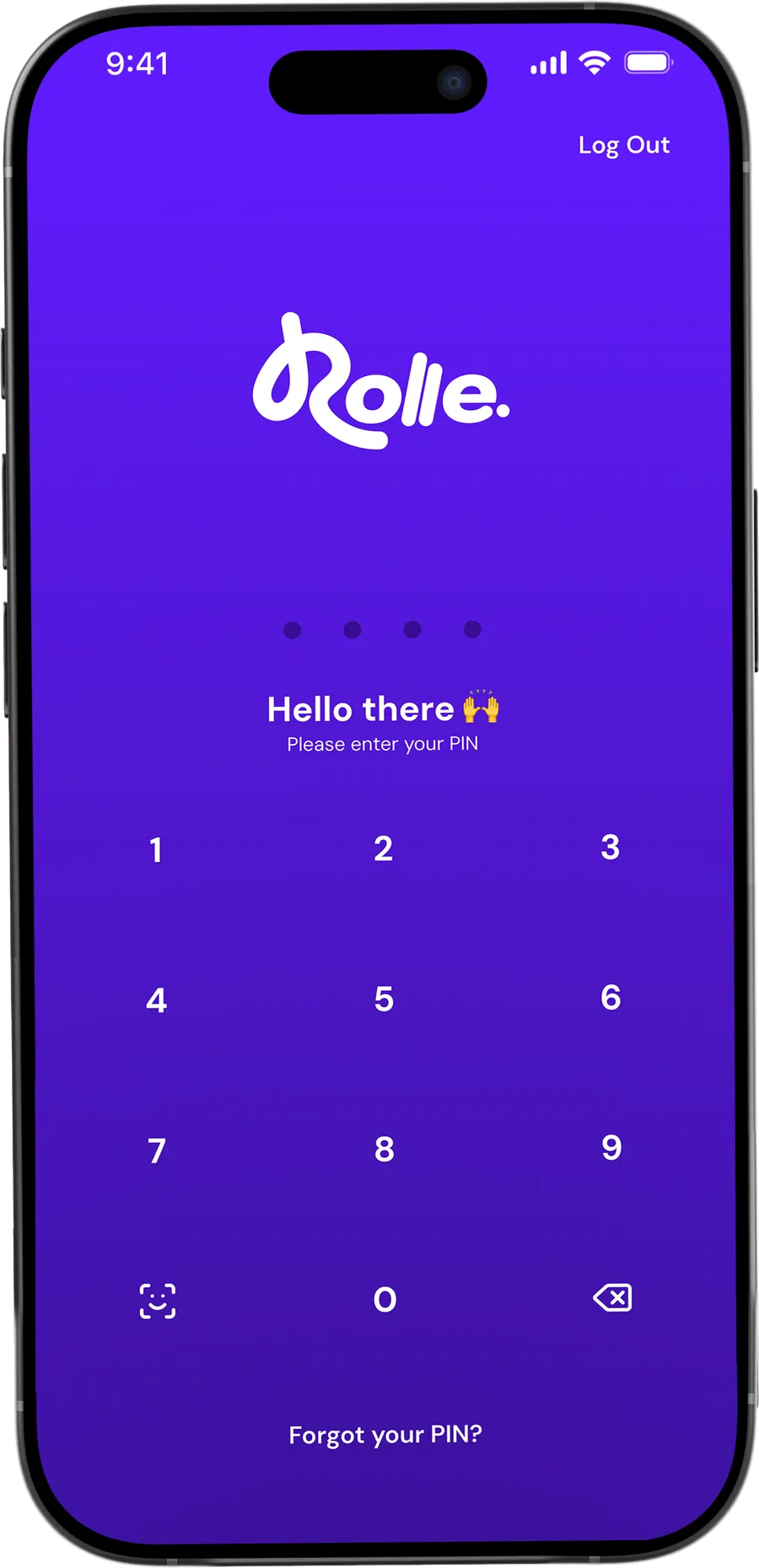
The app also supports an additional Rolle PIN, with protection against repeated incorrect attempts, and can use device security such as Face ID or Touch ID where supported. Your PIN is not stored in readable form.
- Authenticated account
- Additional app lock
- Device biometrics where supported
Server-side validation
The app doesn't get the final say over money.
A secure financial product should not trust an instruction simply because it came from the screen in front of you.
Rolle separates what happens in the app from the systems responsible for validating sensitive financial actions.
When an operation involves money, Rolle's secure server-side systems check who is making the request and whether they are allowed to make it.
The app itself cannot directly alter a balance or simply declare that a payment has completed.
The app requests. The secure system decides.
Rolle App
Secure Rolle systems
Identity checked · Permission checked · Request validated
Financial action
Frequency
Security isn't something we check once.
Rolle's security controls are part of the way the product is built. Changes to the software go through automated checks covering:
- Account and household permissions
- Sensitive information exposure
- Dependency vulnerabilities
- Accidentally exposed credentials
- Application security
- Encrypted connections
- Software quality
- Automated testing
Some tests deliberately attempt actions that users should not be allowed to perform, trying to access another user's information. If a security issue is found, an automated test is added wherever appropriate so the same issue cannot quietly return later.
- Code change→ checks begin
- Permission tests
- Security scans
- Automated tests
- Build→ all checks passed
- Release
Every change is checked before it ships.
Access model
Built around permission.
A simple principle sits behind Rolle's security model:
Don't give access first and try to restrict it later.
Rolle starts from no access and grants only the permissions needed for the person, household and action involved. That principle applies across household information, financial activity and the systems behind the app.
Default state
No access
Permitted routes open only where access is granted
- YouYour personal data and account
- Household memberShared household obligation only
- Secure systemApproved financial action
Financial infrastructure
Specialist financial infrastructure where it belongs.
Rolle is designed to work with regulated financial infrastructure for services such as payments and Open Banking. Different parts of a Rolle transaction may be provided by specialist financial partners. That separation is deliberate.
Coordinates between
Open Banking
Permissioned account connections
Payments
Card and bank payment processing
Banking Infrastructure
Regulated payment rails
Rental Systems
Property and tenancy platforms
Still have security questions?
If there is something about security, privacy or the way Rolle handles your information that is not answered here, talk to us.